

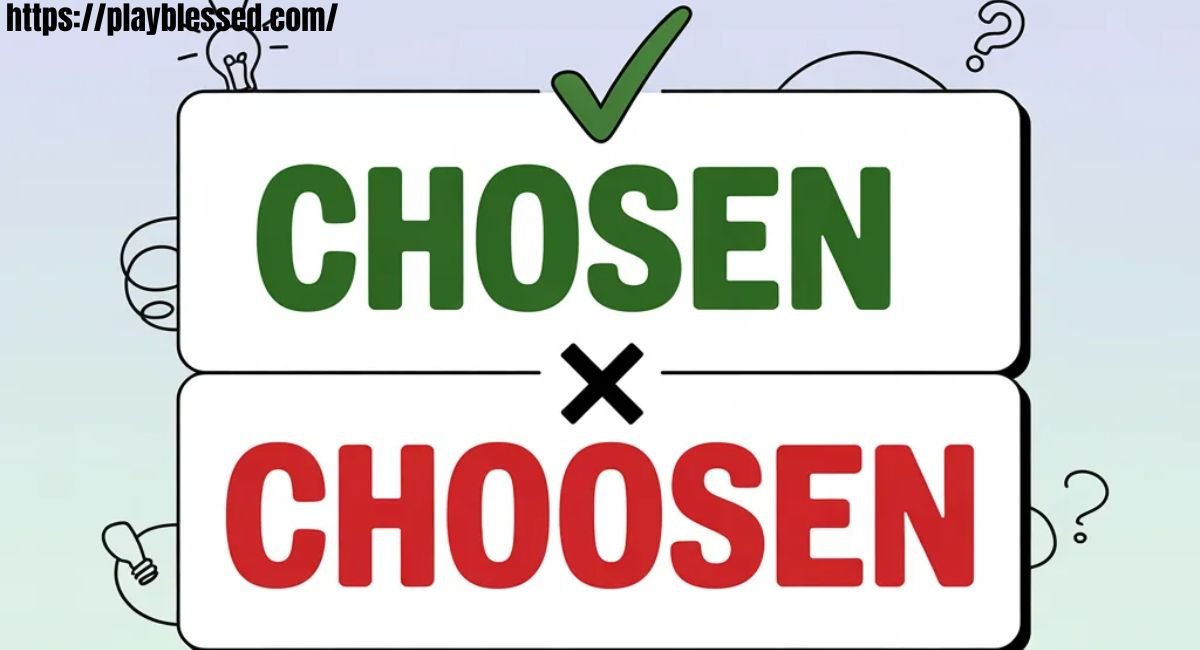
Chosen or Choosen You’re typing an email, a school assignment, or maybe a social media caption and suddenly you pause. Is it chosen or choosen? Both look oddly familiar. Both feel like they could be right. But here’s the truth: one of them doesn’t exist in the English language at all.
This is one of the most Googled spelling questions in the world and for good reason. The confusion is real, it’s widespread, and it catches even confident writers off guard. Chosen or Choosen In this guide, you’ll get a straight answer, a clear grammar explanation, and enough real examples to never second-guess this word again.
Chosen or Choosen? The Answer in One Line
“Chosen” is correct. “Choosen” is always wrong.
There is no context, dialect, or style guide where “choosen” is acceptable. Chosen or Choosen It is not informal English, it is not a British variant, and it is not a historical spelling that fell out of use. It is simply a misspelling—one of the most searched grammar mistakes on the internet today.
What Does “Chosen” Mean?
“Chosen” is the past participle of the irregular verb to choose.Chosen or Choosen It is used to indicate that a selection or decision has already been made, and it typically appears alongside helping verbs like have, has, had, was, or been.
As a verb (past participle):
- She has chosen a new career path.
- The winner was chosen by a panel of judges.
- They had chosen the restaurant before I arrived.
As an adjective:
- He was the chosen candidate for the role.
- “The chosen one” is a phrase used in both religious texts and popular culture.
In both roles—verb and adjective—the word carries a sense of deliberate selection, often implying preference, merit, or honor.
The Origin of “Chosen”

Chosen or Choosen Understanding where a word comes from can make its spelling click immediately.
The verb choose traces back to the Old English word ceosan, meaning “to choose, seek out, select from two or more.” Its Old English past participle was coren, derived from Proto-Germanic keus-, a root also found in Dutch kiezen, Old High German kiosan, and Gothic kiusan.
The irregular past participle gradually standardized to chosen by around 1200 CE. This “-en” ending is a hallmark of what linguists call strong verbs verbs that change their internal vowel to signal tense rather than simply adding “-ed.” Think of the patterns:
| Base Form | Simple Past | Past Participle |
|---|---|---|
| speak | spoke | spoken |
| break | broke | broken |
| freeze | froze | frozen |
| choose | chose | chosen |
Notice how none of these past participles double the vowel from the base form. “Choosen” breaks this consistent pattern entirely.
Why Do People Write “Choosen”?
The misspelling makes a certain kind of Chosen or Choosenintuitive sense, which is exactly why it keeps appearing. There are two main reasons behind it:
1. Carrying the double-O from “choose”
The base verb choose has two O’s. When forming the past participle, some writers instinctively keep both, producing “choosen.” This is a case of overgeneralizing a spelling pattern rather than following the actual grammar rule.
2. Phonetic spelling
In natural speech, the “o” in chosen can sound slightly elongated. Speakers who rely on sound to guide spelling sometimes interpret that elongated vowel as two O’s—and write “choosen” as a result.
The misspelling also likely arises from overgeneralization: people apply the more common rule of adding “-ed” for the past tense to irregular verbs, and since “chosen” sounds like it could have two syllables, some assume an extra ‘o’ is needed.
Neither of these instincts produces a correct result. The spelling chosen has been standardized in English for over 800 years.
British English vs. American English Spelling
Chosen or Choosen One of the first questions people ask is whether “choosen” might be a valid British spelling, the way “colour” differs from “color.”
The answer is no and this is one area where both dialects fully agree.
There is no spelling difference between British and American English for this word. Both use chosen exclusively. Unlike words such as organise/organize or centre/center, this word has never split along regional lines. Whether your audience is in London, New York, Sydney, or Karachi, the rule is the same: chosen, always.
Which Spelling Should You Use?
Chosen or Choosen Since “choosen” is never correct, this is an easy call:
- Academic writing: Use chosen anything else would be flagged as a spelling error.
- Professional emails and reports: Use chosen it reflects precision and credibility.
- Creative writing and fiction: Use chosen strong verb forms add rhythm and authority.
- Social media and casual texts: Use chosen even informally, correct spelling builds trust.
- ESL and language learning contexts: Use chosen it’s the only form recognized by any English dictionary.
There are zero exceptions.
Common Mistakes with “Chosen”
Chosen or Choosen Beyond the chosen/choosen confusion, writers sometimes mix up the three main forms of the verb choose. Here’s a breakdown of the most frequent errors:
Mistake 1: Using “chose” where “chosen” is required
Incorrect: I had chose to stay home. Correct: I had chosen to stay home.
When a helping verb like had, have, or has precedes the verb, you need the past participle chosen, not the simple past chose.
Mistake 2: Using “chosen” where “chose” is required
Incorrect: Yesterday, she chosen a new laptop. Correct: Yesterday, she chose a new laptop.
Simple past actions with time markers like yesterday, last week, or in 2020 require chose, not chosen.
Mistake 3: Writing “choosed”
Incorrect: He choosed the blue tie. Correct: He chose the blue tie.
Chosen or Choosen Choose is an irregular verb. Adding “-ed” to form the past tense is a common error for irregular verbs, but choosed is not a word in standard English.
Quick Reference: The Three Forms of “Choose”
| Tense | Form | Example Sentence |
|---|---|---|
| Present (base) | choose | I choose carefully. |
| Simple past | chose | She chose the window seat. |
| Past participle | chosen | They have chosen a winner. |
| Present participle | choosing | He is choosing his words wisely. |
“Chosen” in Everyday Examples
Seeing a word in real sentences is the fastest way to lock in the correct usage. Chosen or Choosen Here are natural, practical examples across different contexts:
In professional settings:
- The committee has chosen a new director for the department.
- The candidate was chosen after three rounds of interviews.
In everyday conversation:
- Have you chosen what to eat yet?
- I haven’t chosen a gift for her birthday.
In formal writing:
- The data set was carefully chosen to represent a broad demographic range.
- The method chosen for this study was peer-reviewed and widely validated.
As an adjective:
- The chosen venue seats 500 guests.
- He delivered the chosen speech with remarkable confidence.
In cultural and literary contexts:
- The phrase “the chosen people” appears across multiple religious traditions.
- In The Matrix, Neo is famously referred to as “the chosen one.”
Chosen or Choosen? – Google Trends & Usage Data
Search data reveals just how widespread this confusion is.
Analysis of search data shows that searches for “choosen” and comparisons like “chosen or choosen” are consistently high worldwide. Chosen or Choosen The United States, United Kingdom, India, the Philippines, and South Africa all show notable search activity for these clarifying phrases. This is not a regional error—it’s a universal English spelling challenge, particularly for non-native speakers and phonetic spellers.
Through the Google Books Ngram Viewer, data shows that chosen has a significantly higher usage rate than its misspelling choosen in published books in both American and British English since 1800. The gap is not even close. “Choosen” barely registers as a blip in published literature, while “chosen” has a long, unbroken record of correct usage across centuries of writing.
Comparison Table: Keyword Variations
| Word | Correct? | Role | Example |
|---|---|---|---|
| chosen | ✅ Yes | Past participle / adjective | “She has chosen a path.” |
| choosen | ❌ No | Misspelling | Never use this form. |
| chose | ✅ Yes | Simple past tense | “He chose wisely.” |
| choose | ✅ Yes | Base / present tense | “I choose you.” |
| choosing | ✅ Yes | Present participle | “Choosing is hard sometimes.” |
| choosed | ❌ No | Misspelling | Never use this form. |
FAQs:
Is “choosen” ever correct in any dialect of English?
No. “Choosen” is not valid in British, American, Australian, or any other recognized dialect of English.
What is the past participle of “choose”?
The past participle is chosen. It follows the pattern: choose → chose → chosen.
Can “chosen” be used as an adjective?
Yes. For example: “the chosen candidate” or “a chosen path” uses chosen as a descriptive modifier.
Is “choosed” a word?
No. “Choosed” is also incorrect. The correct simple past of choose is chose.
Why does spell-check flag “choosen”?
Because it is not a recognized English word. Every major dictionary and grammar tool marks it as a spelling error.
How do you pronounce “chosen”?
It is pronounced CHOH-zen (rhymes with frozen). The “s” sounds like a “z,” and there is only one syllable containing the long “o” sound.
Is there a memory trick to remember which is correct?
Yes—use this chain: Choose → Chose → Chosen. Notice how the double-O disappears after the base form. Once that “o” is dropped in chose, it doesn’t return in chosen.
Conclusion
Chosen or Choosen The spelling debate between chosen and choosen is no debate at all chosen is always correct, and choosen is always wrong. There are no exceptions, no regional differences, and no informal contexts where “choosen” becomes acceptable.
The confusion is understandable. The base verb choose carries a double-O, and phonetic spelling instincts don’t always match standardized English rules. But the pattern is clear and consistent: choose → chose → chosen. Once you see it, you won’t forget it.
Whether you’re crafting a formal report, writing a cover letter, or dashing off a social media caption, using the correct form of this word reflects clarity, credibility, and command of the English language. So the next time you reach for the past participle of choose, you’ll know exactly which spelling to choose.

SEO Content Writer ✍️SEO-Optimized Blogs & ArticlesOn-Page SEO Friendly Content📩 DM for work