
Tailor or Tailer Have you ever typed “tailer” when you meant “tailor” or wondered if both spellings are actually correct? You’re not alone. Tailor or Tailer This is one of those small but surprisingly common spelling slip-ups that can undermine your writing, whether you’re crafting a business email, a blog post, or a fashion piece. Tailor or Tailer In this guide, you’ll get a clear breakdown of what “tailor” means, why “tailer” is almost always wrong, and how to remember the correct spelling every single time.
Tailor or Tailer — Which One Is Correct?
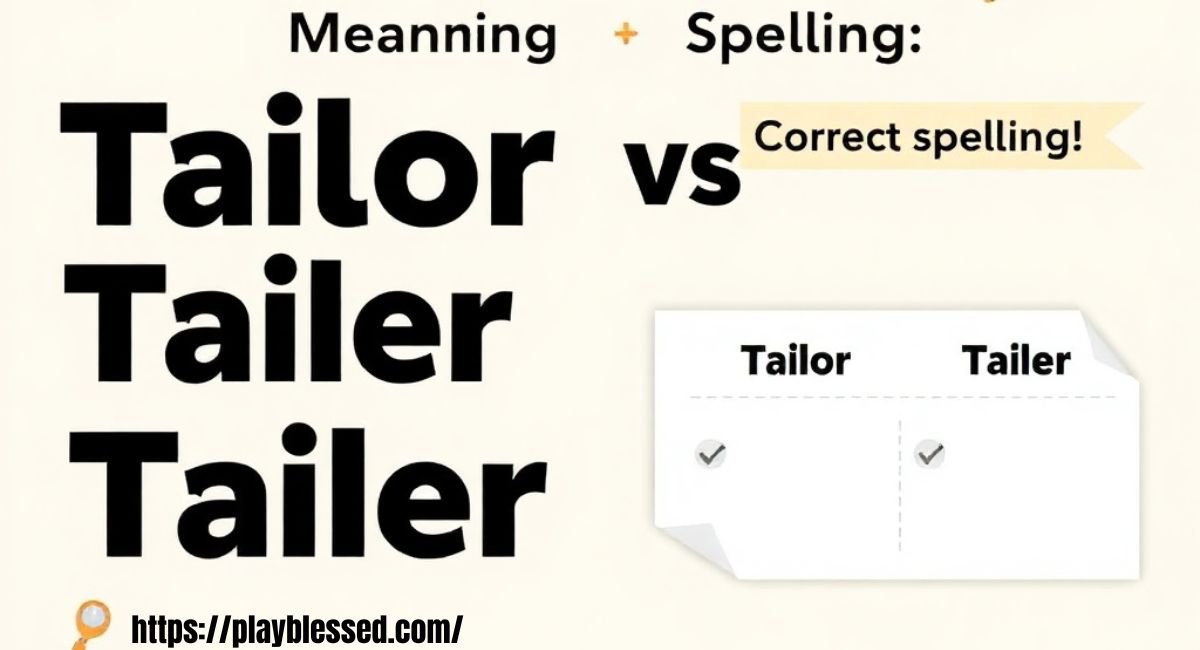
Tailor or Tailer The correct spelling is tailor. The word “tailer” is not a standard English word in most contexts, and using it is generally considered a spelling error. Whether you’re referring to a person who sews clothing or using the word as a verb (meaning to customize something), the correct form is always tailor.
| Word | Correct? | Meaning |
|---|---|---|
| Tailor | ✅ Yes | A person who makes or alters clothing; to customize |
| Tailer | ❌ No (usually) | Not a standard English word; common misspelling |
Quick Answer: If you mean a skilled clothing maker or the act of customizing something, always write tailor never “tailer.”
The Origin of Tailor
Tailor or Tailer Understanding where a word comes from helps you remember how to spell it. The word tailor has a fascinating history rooted in medieval trade.
- It comes from the Old French word tailleur, meaning “one who cuts.”
- That Old French term traces back to the Latin word taliare, meaning “to cut.”
- The word entered Middle English as taillour or tailour in the 13th century.
- By the 14th century, it had settled into its modern form: tailor.
The “-or” ending is not accidental. In English, many occupational words use “-or” to indicate a person who performs an action such as doctor, actor, senator, and tailor. This pattern is your best clue for spelling it correctly.
British English vs. American English Spelling
One reason people get confused is the assumption that British and American English spell the word differently. Fortunately, this is one case where both varieties agree completely.
| English Variety | Spelling Used |
|---|---|
| American English | Tailor |
| British English | Tailor |
| Australian English | Tailor |
| Canadian English | Tailor |
Tailor or Tailer There is no regional variation when it comes to “tailor.” Both British and American English use the same spelling, with the same “-or” ending. This consistency makes it easier to commit to memory: no matter where you are in the world, “tailor” is correct.
Which Spelling Should You Use?
Simple: always use tailor. Here’s when each usage applies:
As a Noun
A tailor is a skilled professional who makes, repairs, or alters clothing especially suits, jackets, and formal wear.
Example: “She took her wedding dress to a tailor for last-minute alterations.”
As a Verb
To tailor something means to adapt or customize it for a specific purpose or audience.
Examples:
- “We need to tailor our marketing strategy to reach younger audiences.”
- “The program was tailored to meet the needs of adult learners.”
- “He tailored his resume for each job application.”
As an Adjective (Tailored)
The past participle tailored is widely used to describe something that has been specifically designed or fitted.
Tailor or Tailer Examples:
- “She wore a beautifully tailored blazer to the interview.”
- “The company offers tailored solutions for small businesses.”
Common Mistakes with Tailor
Spelling errors with this word tend to follow predictable patterns. Here are the most frequent mistakes writers make — and how to avoid them:
Mistake 1: Writing “Tailer” Instead of “Tailor”
Tailor or Tailer This is the most common error. The “-er” ending feels natural to many writers because English often uses “-er” for people who do things (teacher, writer, farmer). However, “tailor” follows the Latin-derived “-or” pattern, not the native English “-er” pattern.
Wrong: The tailer adjusted the hem of the trousers.
Right: The tailor adjusted the hem of the trousers.
Mistake 2: Confusing “Tailor” with “Taylor”
Taylor is a proper noun a surname and a first name (like Taylor Swift). It is not interchangeable with tailor (the common noun meaning a clothing maker or the verb meaning to customize).
Wrong: We need to taylor the report to the client’s needs.
Right: We need to tailor the report to the client’s needs.
Mistake 3: Forgetting the Verb Form
Many people know “tailor” as a noun but forget it also functions as a verb. Phrases like “tailor your approach” or “tailor-made solutions” use the verb or adjective form of the same word.
Tailor in Everyday Examples
Tailor or Tailer Seeing a word in real-world sentences helps lock in the correct spelling and meaning. Here are natural examples across different contexts:
In fashion and clothing:
- “The bespoke suit was crafted by an experienced tailor in London.”
- “A good tailor can make an off-the-rack suit look custom-made.”
In business and marketing:
- “You should tailor your pitch deck to each specific investor.”
- “Our team creates tailor-made digital campaigns for every client.”
In education:
- “The curriculum was tailored to accommodate students with different learning styles.”
- “Teachers are encouraged to tailor lessons to classroom needs.”
In technology:
- “The software allows users to tailor the interface to their workflow.”
- “AI tools can tailor content recommendations based on user behavior.”
Tailor – Google Trends & Usage Data
Tailor or Tailer Search volume and usage data confirm that “tailor” is the overwhelmingly dominant spelling online. “Tailer” barely registers as a search term in any meaningful context.
| Term | Google Trends Popularity | Common Usage Context |
|---|---|---|
| Tailor | Very High | Fashion, business, education, tech |
| Tailor-made | High | Marketing, products, services |
| Tailored suit | High | Men’s fashion, formalwear |
| Tailer | Very Low | Rare, mostly misspellings |
| Taylor | High | Proper noun (names, Taylor Swift) |
Tailor or Tailer The phrase “tailor-made” has seen especially strong usage in business writing over the past decade, reflecting how the word has expanded well beyond its original fashion context into virtually every professional field. Phrases like “tailored approach,” “tailored solutions,” and “tailor your strategy” appear regularly in corporate communication, digital marketing, and educational content.
FAQs
Is “tailer” a real word?
No, “tailer” is not a standard dictionary word in English. It is almost always a misspelling of “tailor.” In extremely rare technical or dialectal contexts it might appear, but in general writing, always use “tailor.”
What does tailor mean in simple terms?
A tailor is a person who makes or adjusts clothing. As a verb, to tailor means to customize or adapt something for a specific need.
Is “tailor” spelled the same in British and American English?
Yes, both British and American English spell it the same way: tailor. There is no regional spelling difference.
What is the difference between “tailor” and “Taylor”?
“Tailor” is a common noun or verb related to clothing and customization. “Taylor” is a proper noun a name. Never use “Taylor” when you mean the verb or occupation.
Can “tailor” be used as a verb?
Yes. “To tailor” means to adapt or customize something. For example: “We tailored the service to fit their budget.”
What does “tailor-made” mean?
“Tailor-made” means specially designed or perfectly suited for a particular purpose or person, like a tailor-made suit or a tailor-made solution.
Why do people misspell “tailor” as “tailer”?
Because the “-er” suffix is very common in English for people who do things (writer, baker, teacher). Writers instinctively apply it, forgetting that “tailor” uses the Latin-derived “-or” ending instead.
How do I remember the correct spelling of “tailor”?
Think of the word’s cousins: doctor, actor, senator all people, all ending in “-or.” Tailor fits the same mold. You can also remember it by its origin: from the Latin taliare, “to cut.”
Conclusion
Tailor or Tailer The answer is clear and consistent: tailor is the correct spelling always. Tailor or Tailer Whether you’re describing a skilled clothing craftsman, customizing a business strategy, or writing about tailor-made products, the “-or” ending never changes.
“Tailer” is simply a misspelling, not an accepted alternate form in British English, American English, or any other major variety of the language. Remembering the word’s Latin roots and its connection to other “-or” occupational words (doctor, actor) is the easiest way to lock in the correct spelling for good.

SEO Content Writer ✍️SEO-Optimized Blogs & ArticlesOn-Page SEO Friendly Content📩 DM for work